

It's been a little while since I wrote a Sunday Substack. I’m here with a cup of coffee, listening to the rain hit my back deck. The doors are open with only the screens keeping the bugs out and the dogs in, and the petrichor is creeping through (one of my favorite smells ever). I had every intention of going to the farmers market this morning, but the rain made that decision for me, and now my morning has opened up. So, here we are.
Last week I had a long drive, and I look forward to these. The ironic thing about having a platform and talking to thousands of people at once (eek!) is that, at my core, I am an introvert. I am still the little girl hiding behind her mother’s legs, using her skirt as a curtain to block out the world. That sometimes surprises people, because I can push myself through spurts of human contact just fine, but my social battery has a short life.
Anyway, on this drive I had carte blanche on how to spend an hour and a half of beautiful solitude. No requests from my two favorite little humans. No husband whose taste in music and audiobooks could not be more different from mine. Feeling adventurous, I let Spotify recommend some podcasts to me. I was curious what would get served up to a millennial mother like me. What did the algorithm think would speak to me?
I landed on a show hosted by two women. I’ve heard people talk about it, so I gave it a try. I’d rather not name it, because the specific podcast isn’t the point. It has millions of listeners and covers current events with a slant toward pop culture. It had nothing to do with health or science (which I appreciated, since my brain sometimes needs a palate cleanser), and that’s exactly why the ads smattered throughout the episode caught my attention. So, what was the algorithm trying to tell me? Let’s discuss…
Three themes from behind the wheel
Using some very informal thematic analysis from behind the wheel, I quickly realized a trend.
“Natural is better,” and it’s the default. Ad after ad rattled off the list of what was NOT in the product. Non-GMO. Organic. Nontoxic. No artificial dyes. No preservatives. No ingredients you can’t pronounce. Clean. Green. The usual suspects. One tea described itself as “farm to can” with “simple ingredients,” “never ultra-processed,” and verified by something called the non-UPF verified standard (I have questions).
“Your body needs to be detoxified.” Teas and supplements to cleanse you of whatever the first category was warning you about. One brand offered a “gentle daily detox” built around chlorophyll, plus a beet-based product for cardiovascular health.
“Your body needs to be upgraded.” Peptides. More supplements. Herbal remedies. A “clean cognitive support” blend of yerba mate, nootropics, adaptogens, and botanicals. Everything “inspired by nature,” “pure and potent,” “thoughtfully sourced,” and my personal favorite, “backed by thoughtful science.”
The very first ad of the episode, for the record, was for Starbucks Frappuccinos, with one of the hosts casually describing herself in line for a latte. A Frappuccino contains exactly the kind of preservatives and artificial ingredients every other ad in the episode was warning me about, and nobody seemed to notice the dissonance. To be clear, you will also find me in line for a pecan crunch latte when I feel like overspending on caffeine, so no judgment. I just found the juxtaposition telling.
Dropped in between the ads, and just as casually, was a quiet skepticism of conventional medicine. Nobody said the word "pharma," but the implication ran through the whole episode, that the products we're handed at the pharmacy are someone else's agenda, while the supplements and teas in the ad breaks are somehow not. One of the hosts described being in her trad wife era, baking all of her own bread without the “added junk,” among many other changes she’s made to live what she called the “clean girl life.” None of it was framed as advice. It was just how she lives now, mentioned the way you’d mention a new haircut.
It’s not just this one podcast
This all lined up with clips that have been showing up in my own feed lately, from women around my age with enormous audiences. Gwyneth Paltrow explaining that she takes her coffee with raw heavy cream (emphasis on the raw), which surprised no one. Dakota Johnson walking through the supplements she takes each morning. The one that stopped me was Chelsea Handler raving about peptides. I love Chelsea. She is usually the first one to call out nonsense, and here she was, swept up in it.
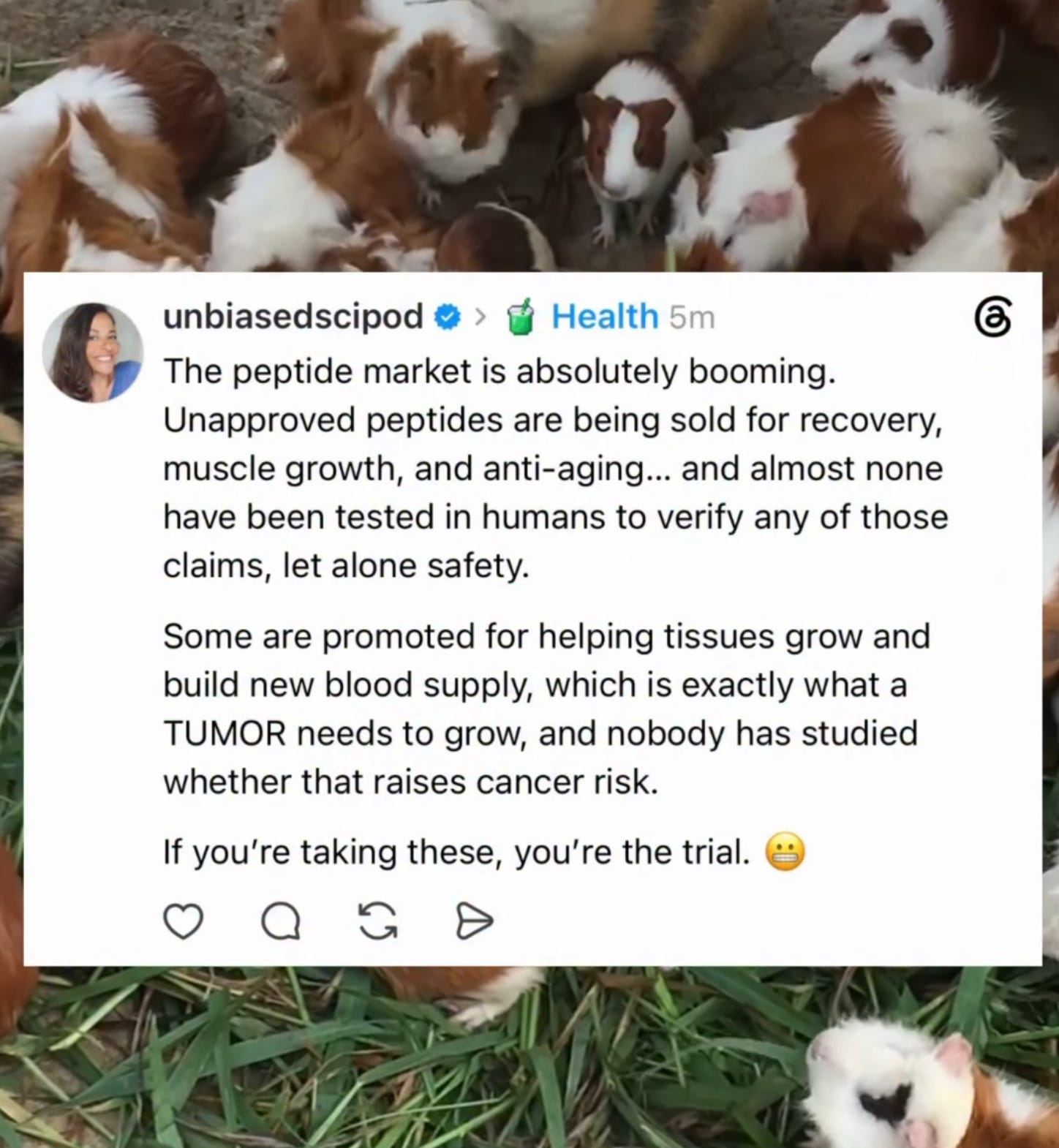
Peptides are on my mind because we recently did a post on them, and I haven’t encountered that level of aggression in my comments in a while (which is saying a lot). If you have the time and the interest, take a scroll through the comments below, though some were filtered out for hate speech, so you won’t get the full experience.
None of what I heard felt like proselytizing, and that’s the part that bothers me. If it had, it would be easy to tune out. Instead, it was subtle, a whole wellness worldview slipped into our ears in between pop culture recaps and celebrity gossip, so seamlessly that it doesn’t register as a claim at all. It has stopped feeling like an ad and started feeling like the norm.
What I would believe if this were my whole algorithm
If this show and others like it were the bulk of what I listened to, I think I would come away believing a few things without ever deciding to believe them.
First, that every ingredient in everything I eat and feed my children is a potential threat, and that the goal is to subtract my way to safety. Second, that my body is accumulating toxins that need to be flushed out on a regular basis, preferably with a tea I ordered online. Third, that a healthy body isn’t maintained so much as optimized, and that optimization comes in monthly subscription form. Fourth, that the doctor’s office and the pharmacy are, at best, a last resort. Fifth, that there’s a discount code for all of the above.
None of these messages is delivered as a lecture, which is exactly why they land. Repetition by voices you already trust and enjoy does the work an argument would otherwise have to do.
The seeds of truth, and the part that got distorted
To be fair, none of this comes from nowhere. Cooking at home more often is a good thing. Paying attention to what’s in your food is a good thing. Being an active participant in your own health is a good thing. Those instincts are healthy, and the wellness economy is very good at recognizing a healthy instinct and selling it back to us with a markup.
The trouble is what gets attached to those instincts. “Pay attention to your food” becomes “fear your food.” “Take care of yourself” becomes “buy this.” “Ask questions of your doctor” becomes “don’t trust your doctor.”
We’ve talked at length here about why we don’t need to fear the things on that list. Genetically modified crops are one of the great success stories of modern agriculture. A virus-resistant papaya rescued Hawaii’s papaya industry after ringspot virus nearly wiped it out, Golden Rice was engineered to fight vitamin A deficiency, the leading cause of childhood blindness in poorer countries, and the insulin that millions of people rely on every day is made by genetically engineered bacteria. A National Academies review of roughly 900 studies found no evidence that GM crops carry more risk to human health than conventionally bred ones. Preservatives are the reason your food doesn’t grow mold or make you sick between the store and your kitchen. “Nontoxic,” “clean,” and “green” aren’t regulated terms with any agreed-upon definition, which is why they can be slapped on anything. What I heard on that drive was a steady, high-frequency dose of the same few ideas over, and over again.
You can search our database or chat with Georgie to find our content on these topics.
I’m not writing this to tell anyone what to listen to or not listen to. Honestly, I enjoyed the episode overall. I chuckled a few times and saw myself in those two women, in some shared life experiences and in where we are in life. I’m writing it because I think most of us don’t clock this stuff as messaging anymore. We hear an ad for a chlorophyll detox, half-listen, and move on to the next segment. But the backbeat is still playing, and we’re making decisions to it, about what to buy, what to fear, and who to trust, without ever quite hearing the song.
Unbiased Scientists in the wild
A few things from our team and scientific advisory board that I’m too proud not to share.
Dr. Izzy Brandstetter Figueroa successfully defended her dissertation and now holds a PhD in epidemiology. She gets mad at us for calling her Dr. Izzy. We are going to keep doing it. We are so proud.
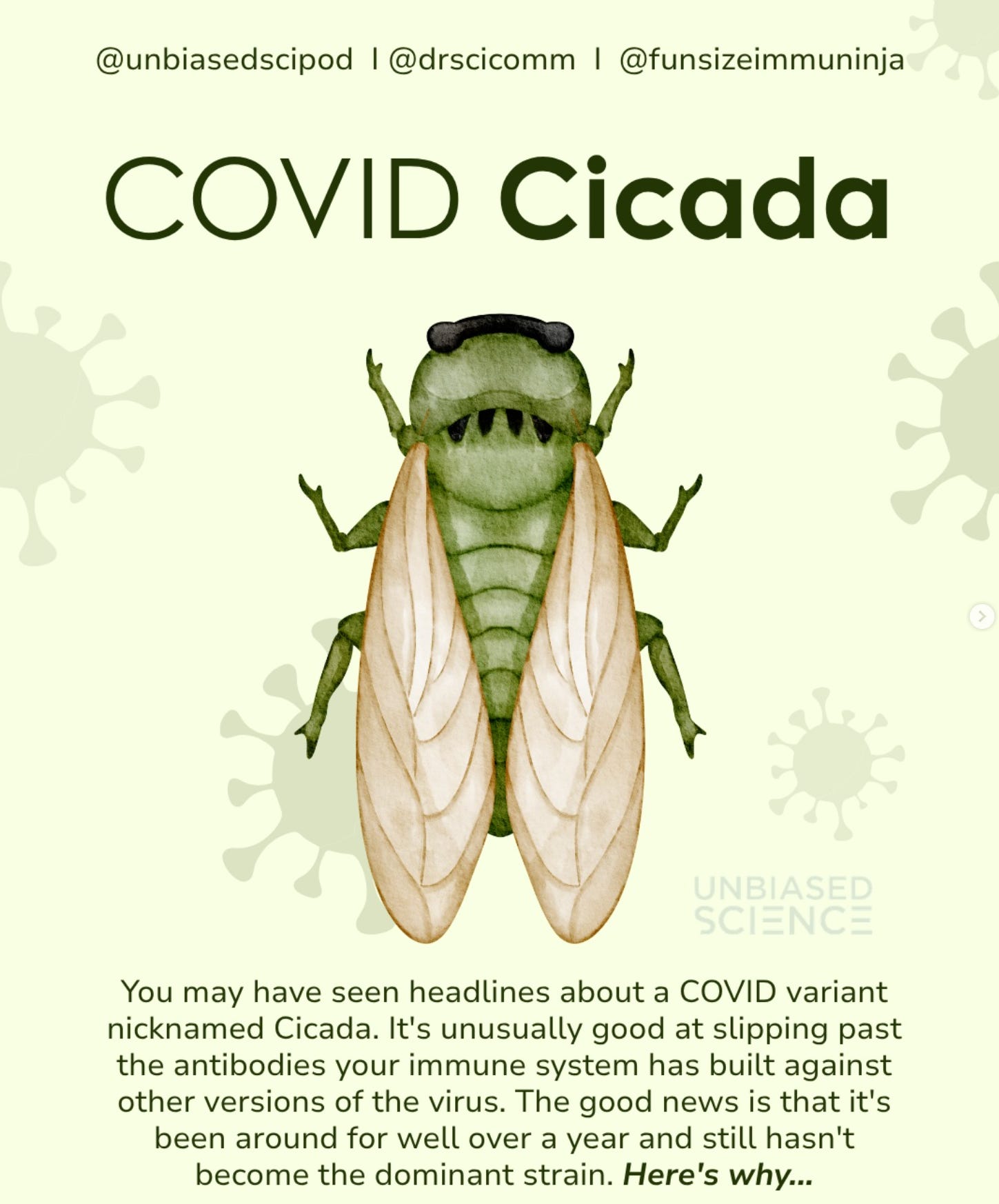
Dr. Aimee Bernard (who celebrated a birthday just a couple of days ago!) and the brilliant Dr. Nina Martin, both immunologists, collaborated with us on a post about the COVID variant nicknamed Cicada, which is unusually good at slipping past our antibodies but still hasn’t become the dominant strain after nearly a year, and what that means for whether this fall’s vaccine matches what’s circulating.
Dr. David Higgins wrote a tragic but extremely important piece on his Substack on the rising number of parents declining the vitamin K shot at birth. It isn’t a vaccine, it prevents life-threatening bleeding in newborns, and nonreceipt has climbed from about 3% to over 5% of births in a few years, with new data showing it higher still in 2026. Please read it.
Two of our scientific advisory board members were also in the news this month. Cosmetic chemist Kelly Dobos was quoted throughout an AARP piece on what to check before buying a beauty “dupe” (starting with whether the label even names a manufacturer, which the law requires), and clinical pharmacist Dr. Jennifer Gershman talked to HuffPost about the quiet from the federal government on fall vaccines and why you don’t need to wait for a campaign to get your flu vaccine (September or October, and before Halloween, is the window).
Happy Labor Day, friends.
Stay Curious,
Unbiased Science
Brilliantly articulated. It’s almost subliminal now, the matter-of-‘fact’ messages, which makes it more dangerous. I have always maintained that there can be an insidious side to language, nuance, and subtleties. That being said, I respect and admire your candor and summarizations; i.e; “a healthy body isn’t maintained so much as optimized, and that optimization comes in monthly subscription form.” We are all part of a herd in many respects, which can serve and promote a positive, unified, and protective purpose - but we also need to be aware of the language in which it’s coined - often innocuously - when it is cooly introduced in pop culture speak - aware that the opposite or negation of the statement is not always true, valid, or the go-to when language is used to make a point. Thank you for bringing this awareness to light and contributing a true and honest public service reflective and backbeat 💕
Great info. Thank you. Congrats to your team members for achieving their goals. It’s distressing to hear about parents refusing the vitamin K shots. This country is teetering on the edge of several horrible outcomes. I appreciate the science based info you provide.