

At some point in the last few years, “is this safe?” stopped being a question about evidence.
Distrust of evidence isn’t new. Anti-fluoridation campaigns go back to the 1950s. AIDS denialism cost hundreds of thousands of lives at the turn of the century. Andrew Wakefield’s fraudulent 1998 study linking MMR to autism was retracted and his medical license revoked, yet the movement it built is still growing decades later.
But what’s happening now isn’t that people have stopped trusting evidence. It’s something stranger: the same person, often within the same week, can refuse a treatment with sixty years of data behind it while ordering an unregulated one online.
Nowhere is this clearer than in pregnancy and the first weeks of a baby’s life, where the stakes are highest and the instinct to protect is strongest. Something interesting is happening there that reveals how our risk processing has changed. We used to fear things like bleeding disorders in infants and pregnancy complications that can harm a future baby. Now we fear the low-risk interventions (vitamin K, RhoGAM) that prevent them. Of course, “we” is a relatively small segment of the population… but it’s growing. Meanwhile, a much larger segment has gone the other direction. Compounded copies of GLP-1 drugs never went through the FDA review that the approved versions did. People are ordering them online in huge numbers because the approved drugs are out of reach, and the risks that come with the compounded versions barely register. Then this week, a small study on Tylenol in pregnancy, built on findings in rats, produced a flurry of headlines and offered another glimpse of how we process risk, this time with the media doing the processing for us. Taken together, these say something about how we judge risk right now, and a lot of it is backward. So, what’s going on, and what does it mean for our families? Let’s discuss…
The shots people are refusing
We have posted quite a bit about the growing refusal of the vitamin K shot, and we are horrified beyond words. A JAMA analysis of more than 5 million hospital births found that the share of newborns not getting vitamin K nearly doubled between 2017 and 2024, from about 3% to just over 5%. That works out to roughly 1 in 20 babies leaving the hospital without protection against a bleeding disorder we solved in 1961 (and that count doesn’t include home births, where refusal runs higher). On top of that, OBs, midwives, and nurses are reporting that, for the first time in their careers, Rh-negative women are turning down RhoGAM. For anyone who hasn’t needed it, a quick explanation of what it does. If you’re Rh-negative and your baby is Rh-positive, a little of the baby’s blood can slip into your bloodstream during pregnancy or birth. Your immune system may identify those blood cells as intruders and build antibodies against them. Often the first Rh-positive pregnancy is unaffected, which is part of what makes the risk easy to shrug off, but the antibodies remain in your bloodstream, and in a later Rh-positive pregnancy they cross the placenta and go after that baby’s red blood cells. The results range from severe anemia to heart failure to stillbirth.

RhoGAM prevents this from getting started. It’s been given to Rh-negative women since 1968, routinely around 28 weeks and again after delivery if the baby is Rh-positive. Before it existed, this disease affected thousands of American babies a year. Today, doctors finishing their training may never see a single case. It is about as close to a solved problem as medicine gets.
People give a few reasons for declining it. One is that RhoGAM is made from donated blood plasma, and the idea of a blood product, and whatever a donor might have had in their system, makes people uneasy. That’s understandable, and it’s also why the plasma is screened, tested, and treated to kill viruses before it goes anywhere near a patient. Another is a black box warning that’s being passed around as a screenshot. That warning is real, but it belongs to WinRho, a completely separate product given in much higher doses for a specific blood disorder, and it has nothing to do with the low-dose shot given in pregnancy. Underneath both, though, is the same thing we saw with vitamin K. Anything injected into a pregnant woman or a newborn is starting to feel dangerous to people, no matter how long it’s been around or how much evidence sits behind it.
The shot people are ordering online
Compounded GLP-1s are the mirror image. When we posted about them, our comment section lit up in a way we haven’t seen in a while, and a lot of the reaction suggested our three main points got lost, so I’ll make them again here.
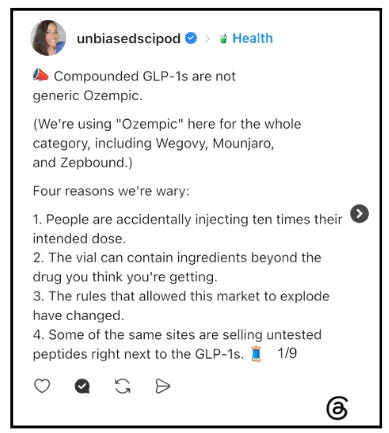
First, compounded is not the same as brand-name or generic. A brand-name drug is the original version a company develops, tests in clinical trials, and patents. A generic is a copy that comes later, once the patent expires. It has gone through FDA review and must match the original’s active ingredient and performance in the body. Generics are usually much cheaper, but GLP-1s don’t have generics yet. Semaglutide (the drug in Ozempic) is patented until 2032, and tirzepatide (in Zepbound) until 2036.
A compounded drug is different from either. It’s mixed by a pharmacy rather than a manufacturer, and the FDA doesn’t check what’s in the vial before it ships. IT’s also usually cheaper. That’s why people looking for something more affordable are turning to it instead. While Ozempic and Zepbound were in shortage, the rules allowed compounders to make what were essentially copies under specific exemptions. Those shortages ended between late 2024 and early 2025, and many companies continued marketing compounded versions anyway, often by tweaking the formula just enough to claim it’s a different product.
Second, the concerns are real. Compounded versions usually come in a vial labeled in milligrams per milliliter, matching how the dose is prescribed. But to actually draw it up, many people use an insulin syringe, which is marked in “units,” a measurement calibrated for insulin, not GLP-1s. That mismatch requires converting the prescribed milligram dose into units. Compounded vials also vary in strength, so that calculation needs to be redone each time. It’s easy to get the math wrong and inject more than intended. When California poison control looked at 36 compounded GLP-1 exposures, 33 were dosing errors, 11 of those were tenfold overdoses, 13 people needed an ER visit, and one was admitted to the hospital. America’s Poison Centers now track these calls nationally, and the trend is up. Some compounders add ingredients or use a different chemical form of the drug than the one that was studied. Separate from legitimate compounding is an even murkier market of “research chemicals“ sold online, including drugs like retatrutide that aren’t approved anywhere yet, and one commenter told us people she knows are dosing those by guesswork.
Third, and we said this in the carousel too, people are buying compounded GLP-1s because the real thing costs a fortune and insurance keeps dropping it. A veteran told us both the VA and her private plan had stopped covering GLP-1s entirely. A nurse said she’d happily take the brand-name version if she could afford it. Several people described losing 60 or 80 pounds and reversing prediabetes on a compounded drug, and I don’t doubt any of it. The drugs work. The cost problem is the reason this whole shadow market exists, and pointing out the risks of the workaround doesn’t change how infuriating the cost problem is.
Still, hold the RhoGAM refusals and the GLP-1 defenses side by side. A plasma product with nearly 60 years of safety data is being refused because it’s a blood product. Meanwhile, people are fiercely defending copies of drugs that haven’t gone through FDA approval, sometimes ordered through a telehealth ad and injected from a vial with a hand-measured dose. Both reactions are understandable, but they aren’t about the evidence. If they were, people would trust the well-studied shot and doubt the untested drug, not the reverse.
The spooky headline that arrived way before Halloween
On Tuesday, a Danish study came out linking acetaminophen use in pregnancy to smaller ovaries in baby girls; within 24 hours, scary headlines claiming “40% smaller ovaries” flooded my feed. We’ve written previously about Tylenol and autism, so the pattern here is familiar. Take an early observational finding, strip out every caveat the researchers put in, and publish something spooky.
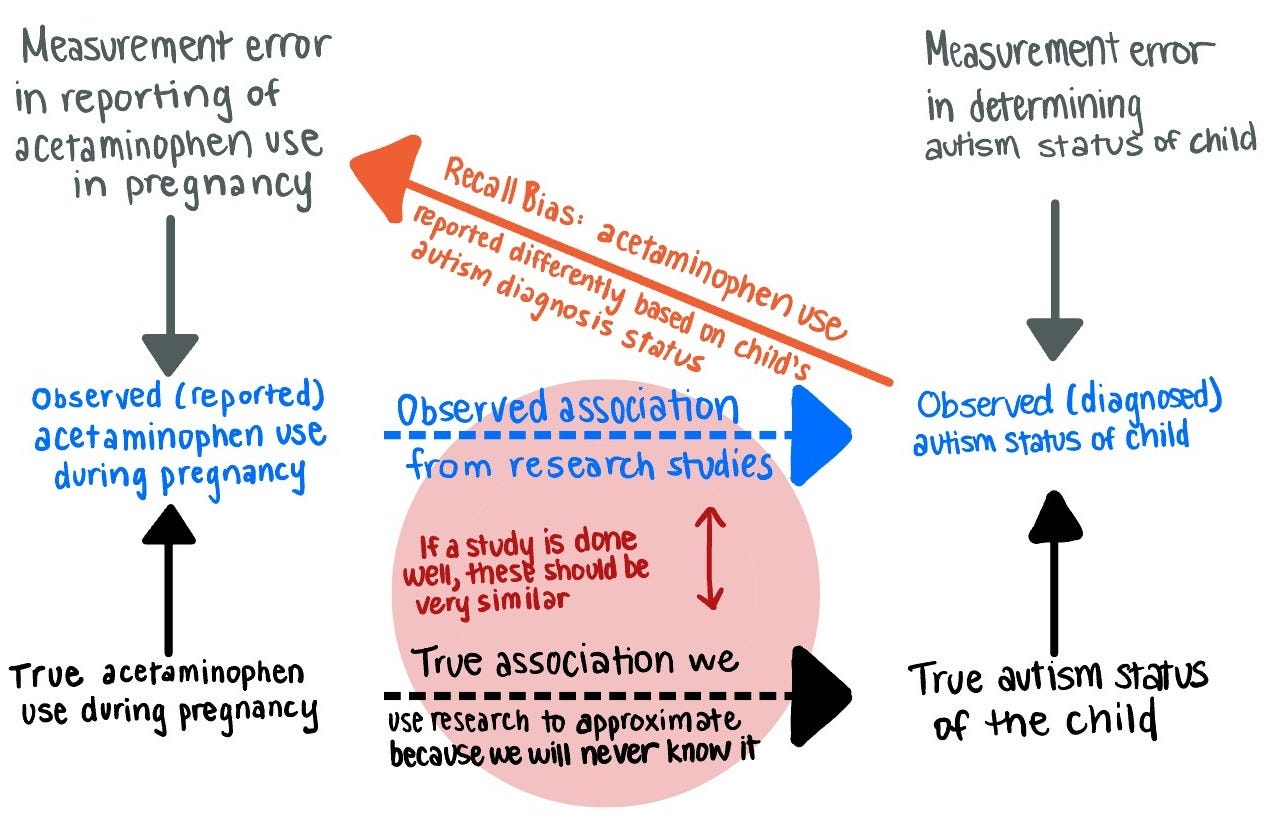
The study followed 302 baby girls and measured their ovaries by ultrasound at three months old. Girls whose mothers had taken acetaminophen early in pregnancy had smaller ovaries and uteruses on average, and girls exposed later had about one fewer follicle. The theory is that acetaminophen may interfere with follicle formation in the developing ovary, fewer follicles would mean less estrogen, and less estrogen would mean smaller estrogen-responsive organs like the uterus, a mechanism supported by earlier animal studies. But a plausible mechanism is only where a research question starts. It cannot confirm whether acetaminophen causes those differences, or whether they have any consequence for fertility decades later. The authors say this themselves, and they add that pregnant women should keep taking acetaminophen when they need it. ACOG said the same.
That “40% smaller” figure floating around is a real number from the study, but the context gets lost in the headlines. The confidence interval on that number is enormous (the true effect could be anywhere from 11% to 70%, and the organ is so tiny that researchers could only measure it in about two-thirds of the babies. When only one ovary could be seen, they doubled its volume or follicle count to estimate the pair. Setting the measurement issues aside, whether that difference or a single follicle means anything for future fertility is completely unknown. The exposed and unexposed groups did meaningfully differ in several ways (e.g. more smoking and more IVF in the exposed group, which the researchers adjusted for). The researchers also ran many comparisons, which they acknowledge increases the odds that some findings are chance.
This study raised a reasonable research question that deserves years of follow-up. It’s just the beginning of that investigation, though, not the end. It is not a reason for a pregnant woman with a fever to tough it out, since an untreated fever carries its own well-documented risks to the baby, and it is not a reason for anyone who treated a migraine during a past pregnancy to lie awake feeling guilty.
What these three decisions have in common
So if it’s not the evidence driving these decisions, what is? Three things seem to be driving them.
Whether you can see the benefit shapes the decision. A GLP-1 can show results on the scale within weeks, so the timing of the payoff is doing a lot of the persuading. RhoGAM protects a pregnancy you may not have for years, so declining it costs nothing today, and the (positive) consequences don’t show up until a later pregnancy. The same goes for Tylenol in reverse, where the harm of an untreated fever doesn’t show up right away, but the scary number in the headline is right in front of you.
Whether the choice feels like yours changes how it resonates. A drug you researched and ordered yourself feels like taking charge of your health, and the people who wrote to us about their compounded GLP-1 talked about it that way, as a decision they made when the system failed them. A shot the hospital tells you to get at 28 weeks can feel like doing what you’re told, and a headline that says the medical establishment overlooked something significant serves to reinforce the belief that you’re the only one looking out for yourself and the system can’t be trusted.
Who you trust matters most of all. One commenter asked, “Can we even trust the FDA now?” It’s a fair question, and we’ve asked it ourselves. But the pattern people fall into is strange: they distrust products regulators have watched for decades, while placing extraordinary trust in products that have never gone through that review at all. And they’re treating a drug our grandmothers took as newly dangerous, just because a headline told them so.
Context is so important, yet it’s the first thing to go. A relative number like 40% is flashy and travels fast, while an absolute difference and the unknown clinical meaning don’t, so a modest early finding turns into a threat. The same thing happens when a black box warning for a completely different product gets passed around as a reason to refuse RhoGAM. Without proper context, almost anything can be made to look dangerous.
None of this makes anyone irrational. These are predictable forces, and they act on all of us. In the information environment we’re living in, evidence has a hard time competing with any of them.
What we’d say
If you’re Rh-negative and thinking about declining RhoGAM, talk it through with your clinician first. There are real exceptions, since you don’t need it if both you and the baby’s father are confirmed Rh-negative, or if a blood test shows the baby is Rh-negative. There’s some disagreement among medical groups about very early pregnancy losses, so what’s right for you depends on the specifics.
If you’re on a compounded GLP-1, find out which pharmacy makes it and whether it’s licensed in your state. Confirm your prescribed dose in milligrams, check your vial’s concentration (mg per mL) on the label, and have your pharmacist show you exactly which mark on the syringe corresponds to your dose. Don’t calculate it yourself or guess based on a previous vial. Save the poison control number (1-800-222-1222, free and confidential), and stay far away from anything labeled a research chemical.
If you’re pregnant with a headache or a fever, acetaminophen remains the recommended first-line medication for pain and fever in pregnancy. Take it when you need it, as directed, at the lowest effective dose for the shortest time necessary.
None of this is an argument for trusting blindly. Ask your clinician about RhoGAM, and ask them why vitamin K matters so much. But read past the headlines, and scroll past the social media posts that prey on your fears and are built to get a strong emotional reaction out of you. Trust that your clinicians, who swore an oath to do no harm, have your best interests at heart and are working from the best available evidence. If a headline rests on a single study, take a pause and ask a few questions. Do we have human data? Do other studies point the same way? Has anyone shown that the finding means something for actual health? The answer may turn out to be yes, but it may also be far too early for that study to set off your risk alarm, and knowing the difference is most of what it takes to get this right.
Stay Curious,
Unbiased Science
Well written and clear. We need more articles like this to educate people about real risk! Thanks for this.
Excellent analysis. I especially appreciate the summary and how humans are swayed by “seeing” the difference a drug makes.