

Welcome to our biweekly series in partnership with CIDRAP at the University of Minnesota. October is here, and so is respiratory virus season. This past month, we shared a lot of content on CIDRAP’s Vaccine Integrity Project reviews of flu, COVID, and respiratory syncytial virus (RSV) vaccines, and many of you asked why we didn’t address long COVID. For many of you, avoiding long COVID—when COVID symptoms linger past three months, and new problems might also arise—is one of the main reasons to get vaccinated.
The reviews focused on outcomes like infection, hospitalization, and death (along with safety) and didn’t assess long COVID, so we couldn’t speak to it from that work.
So, this edition starts with Izzy’s breakdown of a study on whether COVID vaccination lowers the risk of long COVID, including during the Omicron period and among people who had a previous infection. Then we’ll catch you up on vaccine policy, including some big changes to how the CDC counts measles deaths and COVID levels. Let’s discuss…
Do COVID Vaccines Lower the Risk of Long COVID?
I haven’t had long COVID myself, and I can’t (and won’t) speak for people who have. Early in the pandemic, I worked with a team of researchers to follow people who had been hospitalized with severe COVID to study their long-term immune responses, including what long COVID might look like on the immunologic level in those with persistent symptoms.
Years later, they would call to ask us when their next visit was, and whether they could come in sooner. They wanted to help find answers, often so others wouldn’t have to go through what they had.
Patients were the first to recognize long COVID, and the first to name it. In 2020, people were describing months-long, debilitating symptoms after getting COVID. When Elisa Perego used #longcovid in May 2020, it gave people a label they could search for and use to find each other. (Amid all the harm of the pandemic, patients finding and supporting one another was a bright spot.) The term started as a broad umbrella and now describes a recognizable core of symptoms (such as fatigue, brain fog, dizziness, and post-exertional malaise) lasting at least three months. For many people, it’s disabling, and about one in five adults with long COVID report significant limits on their daily activities.
This paper from Quebec, published online in Clinical Infectious Diseases in September 2025, asks how well vaccination protected against long COVID before and after Omicron arrived, how that protection changed over time, and how vaccination plus a past infection (”hybrid immunity”) compared.
Who was studied, and how?
Quebec healthcare workers answered an online survey in spring 2023, which was linked to their vaccine and lab records. Only 5.6% of the 400,222 invited responded, mostly middle-aged women, so we can’t confidently apply the findings to men, children, or older adults. Healthcare workers also differ from the general population in masking habits and COVID exposure.
Compared with what?
The study uses a test-negative design, which helps with that testing problem. Because everyone was sick enough to get tested, differences in who seeks care or who gets a test are largely evened out. It doesn’t remove every bias, but it’s a standard approach in vaccine studies.
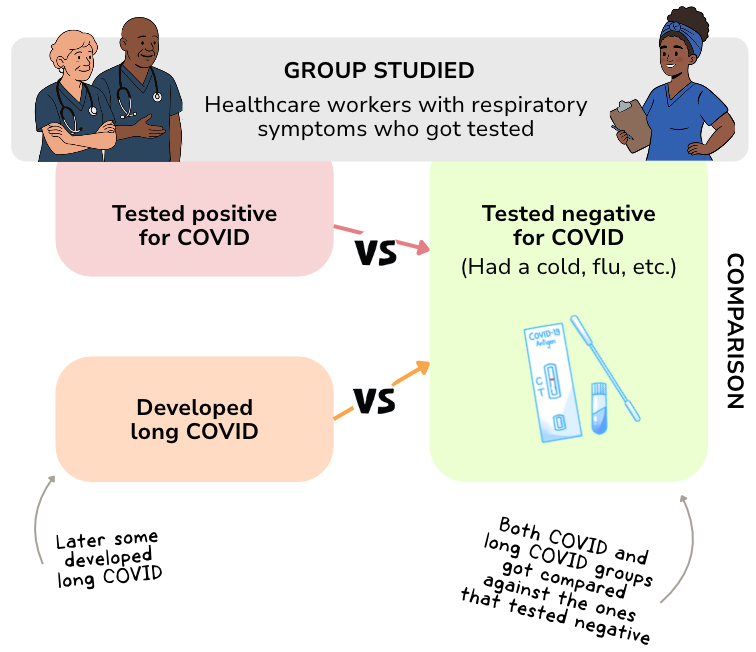
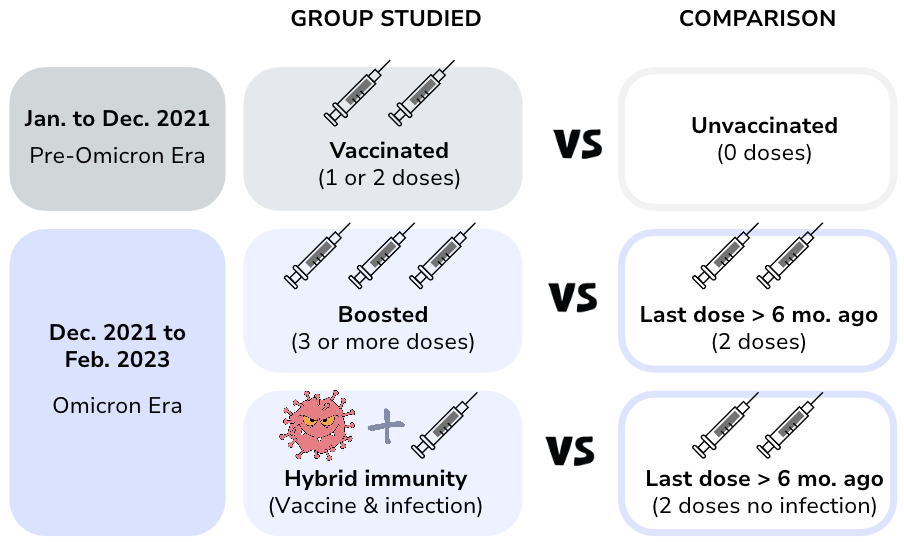
The comparison group also changed over time, because by Omicron almost no one was unvaccinated, so people with three or more doses were compared with people whose second dose was more than six months old. Those are different questions, so we can’t line the pre-Omicron and Omicron results up head to head.
How sure are we?
Before Omicron, vaccinated healthcare workers had about an 87% to 91% lower risk of long COVID than unvaccinated ones. This study had only 95 long COVID cases from that period and the two-dose result is based on just 35 of them, so the ranges are wide. Those percentages are the study’s best estimates, but the true effect of two doses could plausibly be anywhere from the 20s to 98%. During Omicron, a booster was associated with about a 57% lower risk overall, but the benefit shrank from about 70% soon after the shot to about 30% six months later, with a confidence interval dipping too low to rule out no benefit.
Vaccination plus a past infection looked strongest, at 80% to 90%, though that group left out anyone who had long COVID after their first infection. People who got through a first infection without long COVID may simply be less prone to it, so some of that protection may come from them rather than the vaccine. I feel fairly confident about the direction of these results and much less sure about the size.
The authors say vaccination “prevented” long COVID and that their study “confirms” its role. For an observational study, I’d say vaccination was “associated with” a lower risk and the study “contributes to a growing body of evidence.” That difference matters.
Among people who had both a past infection and vaccination, protection against long COVID looked similar regardless of how many doses they’d had or how long ago the last one was. The authors suggest repeated vaccination is “unlikely to provide substantial incremental benefit,” though they say it needs confirmation by others. That applies to long COVID only, in healthcare workers who were already vaccinated and infected. It says nothing about severe illness, which is what the vaccination program is mainly designed to prevent. One thing to keep in mind with all of these percentages is that they’re relative: they tell you how much a vaccine cuts the risk, but not what your specific risk is.
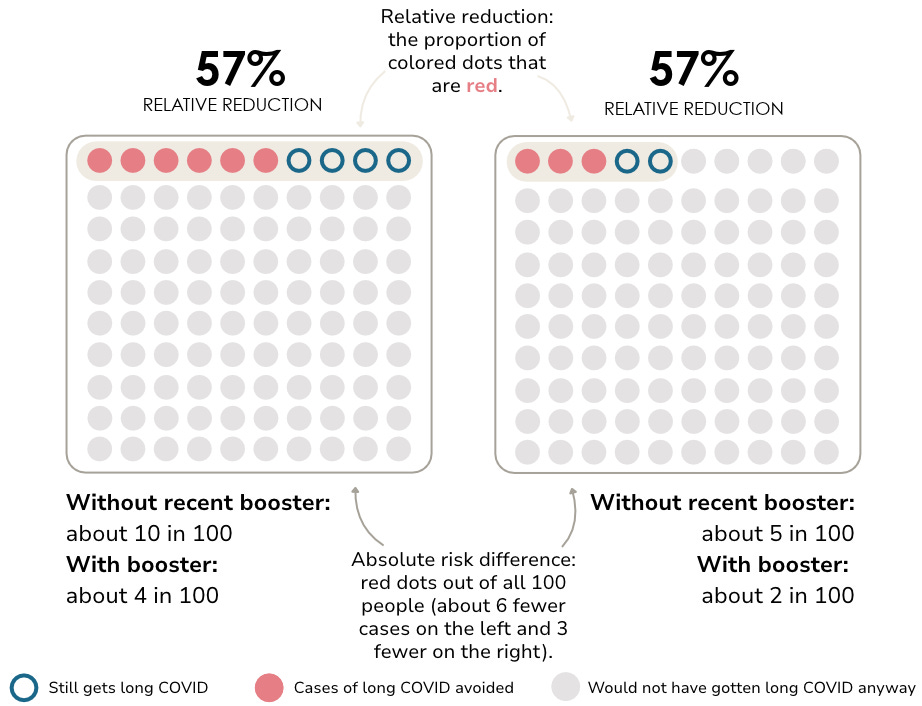
A large 2024 study of U.S. veterans shows the same idea with real numbers. Among veterans infected during the Omicron era, about eight in 100 unvaccinated people developed long COVID within a year, compared to about three to four in 100 among vaccinated people, roughly half. Earlier in the pandemic, the starting risk was higher. In 2020, when almost no one was vaccinated, about 10 in 100 infected veterans developed it. The researchers attributed most of the overall decline to vaccination.
Lower isn’t gone, though. Even three to four in 100 adds up across millions of infections. In a study last month of U.S. healthcare workers infected from 2022 to 2024, more than one in 10 still had moderate or severe symptoms at both three and six months (a different group and method, so not directly comparable).
Putting it all together
I wouldn’t hang everything on any single study, this one included, since each one answers a slightly different question in a different group of people. What matters most is zooming out and reading a paper in context. A 2025 review that pooled 65 studies found the same direction of effect, with vaccination appearing to lower the risk of long COVID, though by a smaller amount than Quebec’s numbers, and its authors rated their certainty as low.
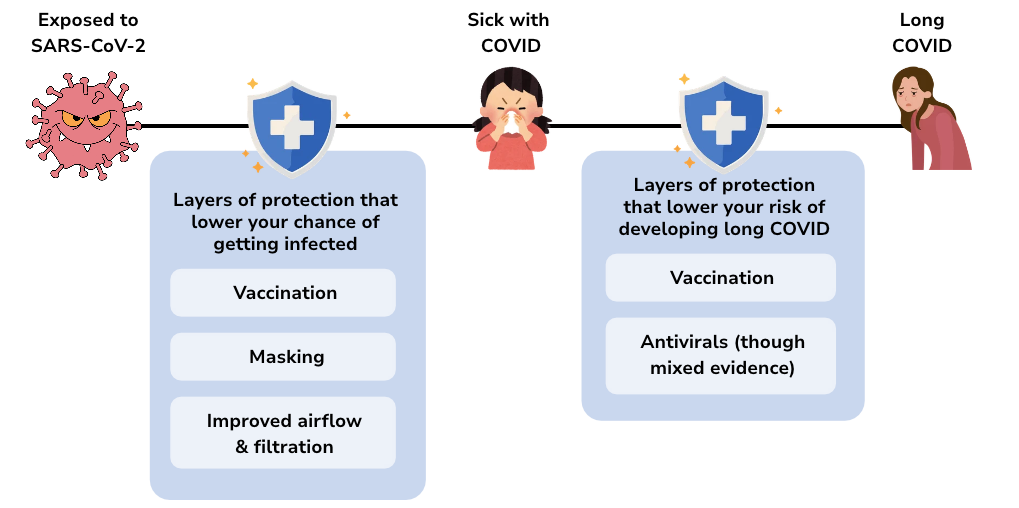
The participants I mentioned at the start wanted others spared what they’d been through, and I think about that a lot when we talk about prevention. Prevention gives the people we love a few more ways to stay well, and it’s never a verdict on anyone who got sick.
The State of U.S. Vaccine Policy, in Brief
Here are some things that caught our attention in the world of vaccine policy over the past two weeks.
1. Kids in the Vaccines for Children program can now get updated COVID vaccines after a month-long delay
On September 23, the Centers for Disease Control and Prevention (CDC) opened ordering for updated COVID vaccines through Vaccines for Children, which supplies free vaccines for about half of U.S. kids (including those on Medicaid and those without adequate insurance). Privately insured kids have had access for weeks, and offices still need shipments to arrive, so call ahead before booking.
The CDC’s updated clinical guidance keeps last year’s recommendations in place “because of legal uncertainties.” The vaccine is recommended for all adults and for children who are moderately or severely immunocompromised. For all other children, it’s left to shared clinical decision-making with their clinician.
The American Academy of Pediatrics (AAP) takes a different approach: it recommends the vaccine for all children 6 to 23 months and for older children at higher risk, and says it should be available to any child whose parents or guardian want it.
The CDC guidance also leaves out much of the evidence on safety and benefits that earlier versions included. The pregnancy section no longer mentions that vaccination during pregnancy is safe and effective and protects babies under 6 months, and now focuses on unknown risks instead.
The American College of Obstetricians and Gynecologists (ACOG), by contrast, continues to strongly recommend COVID-19 vaccination for people who are pregnant, postpartum, or planning a pregnancy. The CDC also dropped its earlier conclusion that the benefits of vaccination outweigh the rare risk of myocarditis (inflammation of the heart muscle), even though the evidence behind it hasn’t changed, and studies of the vaccines given since 2022 haven’t found an increased risk of myocarditis. We’ll have more on that soon.
2. Federal health agencies have stopped their usual campaigns encouraging flu vaccines
As was the case last year, federal health agencies have halted their multimillion-dollar campaigns urging people to get vaccinated against flu and other respiratory viruses. They’ve also scaled back the materials they usually send to clinicians and pharmacies ahead of the season.
Flu vaccines are still recommended for everyone 6 months and older this season, since President Donald Trump’s August executive order calling for an end to that recommendation for children has been held up by a legal challenge. For the first time on record, fewer than half of U.S. children got a flu vaccine in each of the past two seasons. Other groups are stepping in, including Tame It, a National Foundation for Infectious Diseases (NFID) campaign with plain-language guidance on flu, COVID, RSV, and pneumococcal vaccines by life stage (Jess serves on NFID’s Board of Directors).
3. Many hospitals still aren’t giving newborns RSV protection before they go home
A newborn can be protected from RSV by a vaccine given during pregnancy or by an antibody shot given to the baby after birth. The AAP recommends that babies born shortly before or during RSV season who weren’t protected through pregnancy get the antibody in their first week, ideally before leaving the hospital. Many birthing hospitals don’t offer it, largely because insurers’ bundled payment for the birth stay excludes the roughly $500 antibody unless the hospital negotiates separately (the same insurers typically cover it days later at the pediatrician’s office).
Vaccines for Children could supply it free for eligible babies, but only 36% of birthing hospitals were enrolled as of spring 2025. If you’re expecting, ask your hospital before delivery whether it offers newborn RSV immunization. If it doesn’t (and you didn’t get the vaccine during pregnancy), ask for it at your baby’s first pediatrician visit.
4. Pennsylvania has reported 5 measles deaths, but the CDC is counting 2.
Pennsylvania’s outbreak, the largest in the country, passed 900 cases this week, and the state has now reported five measles-associated deaths, all in unvaccinated people. In August, at Health and Human Services (HHS) Secretary Robert F. Kennedy Jr.’s request, the CDC removed those deaths from its dashboard, and it now counts just two nationally without saying where either occurred.
The CDC says it’s working with the Council of State and Territorial Epidemiologists on a standard definition of a measles death (CSTE says that work began this summer as a routine process), and in the meantime it’s waiting for death certificate confirmation, which can take months.
As we wrote in STAT last week, measles can lead to pneumonia, which can lead to respiratory failure. A death certificate lists measles as the underlying cause when it sets off that sequence, even if pneumonia or respiratory failure was the final cause of death. Outbreak tracking has traditionally counted state-reported deaths first, with death certificates confirming them later. The CDC has now reversed that order.
5. Nursing homes may stop reporting weekly COVID cases, and the CDC relabeled its wastewater levels
The Centers for Medicare & Medicaid Services, led by Dr. Mehmet Oz, has drafted a plan to end weekly reporting of COVID, flu, and RSV cases in nursing homes, according to The New York Times. It would also drop the requirement to educate nursing home staff about COVID vaccines and offer them the shots, even though staff vaccination rates have been below 10% in recent years.
Separately, in August the CDC changed how it labels wastewater COVID levels, by recalculating the cutoffs, so a reading that would have been labeled “high” before may now show “moderate.” The underlying data haven’t changed, only the labels. If you use wastewater data to decide when to mask or test, look at whether levels in your area have been rising or falling over the past few weeks on CDC’s wastewater page or WastewaterSCAN, rather than relying on the color alone.
6. The FDA director nominee defended the MMR vaccine after backing splitting it up
Dr. Heidi Overton, nominated to lead the FDA (the agency that approves vaccines), told senators at her confirmation hearing that the measles, mumps, and rubella (MMR) vaccine isn’t lethal and is the best way to prevent measles—a month after standing beside President Trump as he called it “quite lethal.” She also helped develop his August executive order calling for the MMR to be split into three separate shots, which aren’t available in the U.S. and would mean more appointments and longer gaps in protection during an outbreak.
She wouldn’t say whether she’d defy the president if asked to do something that harms public health. Since then, Trump said he’ll demand that drug companies split vaccines into more doses.
Also on our radar
Kennedy gave the keynote at a Children’s Health Defense conference, telling the anti-vaccine group he founded that it has a “friend at the White House.” Washington Post opinion writer Robert Gebelhoff, who is firmly pro-vaccine, attended and argued that mocking the people there only feeds the movement’s resentment.
The Informed Consent Action Network (ICAN) asked HHS to move every vaccine into shared clinical decision-making.
The CDC faces new staff cuts, and the U.S. rejected a U.N. declaration on pandemic preparedness.
Long COVID has no single test and has only had its own diagnostic code since late 2021, which is part of why so many cases may go unrecognized. Measles deaths, nursing home outbreaks, and wastewater levels are much easier to track, and changes in how they’re counted, reported, and labeled can make the picture harder to read.
Those numbers shape decisions like when to wear an effective mask, test, or get vaccinated, so we’d recommend checking your state and local health department data, trackers like WastewaterSCAN, and medical society recommendations (AAP, ACOG, and the American Academy of Family Physicians) alongside the federal numbers. We’ll keep flagging these changes as they happen.
Stay Curious,
Unbiased Science
This piece is cross-posted with CIDRAP.
People increasingly sickened and/or dying of preventable diseases pretty much speaks for itself in terms of vaccine efficacy. Covid and flu obviously still need to be defended against with safe and efficient vaccines especially for those most vulnerable and/or with chronic disease conditions.
It is absolutely unacceptable for govt. officials regardless of their (ill appointed) status to tweak any data collection or change any professional documentation to align with their unscientifically dangerous and conspiracy-based supposed public health guidance.
Your correction of "prevented" to "associated with" is the most important sentence in this piece — and it isn't just style. On the pharmacy counter, we live inside that distinction every day: every prescribing-information section says what a drug is indicated for, not what it "prevents," precisely because observational data can't bear the verb. The Quebec authors overreached; you caught it.
What jumped out at me clinically was the waning curve hiding behind the headline 57%: about 70% soon after the booster, roughly 30% at six months, with the confidence interval flirting with zero. That's the number that actually changes a counseling conversation, because it expires faster than the recommendation does. The authors' own caveat — that repeated vaccination is "unlikely to provide substantial incremental benefit" for long COVID while saying nothing about severe disease — deserves to be quoted more often than it will be.
One question I keep turning over: did the month-long VFC ordering delay and the "shared clinical decision-making" framing effectively turn a logistics failure into a recommendation failure? By the time ordering opened on September 23, the hesitancy architecture was already built.