

We've been busy at Unbiased Science, so here's a roundup of what we've been working on (and where you can find it). Much of what we put out this week started with questions many of you asked us. We read all of your comments, and they shape what we cover, so our content responds to the concerns and questions you bring to us. You’ll see that reflected everywhere, from our new podcast season to a Q&A answering the vaccine questions you sent us. Let’s discuss…
A new season of the Unbiased Science podcast is here
Our biggest news is that a new season of the podcast just dropped with a fresh format. Each episode starts with a question people are asking, and we bring in experts from different fields to tackle it from different perspectives. We’ll share where the evidence and scientific consensus land, and we’ll show you how experts weigh that evidence along the way. Our goal is to share unbiased science and also to help you think like an unbiased scientist.
Our first question is whether our food supply is safe, and we wanted to come at it from several angles. Dr. Michael Osterholm, director of CIDRAP, is an epidemiologist with decades of experience, including in foodborne illness. Dr. Joe Zagorski is an immunotoxicologist at Michigan State’s Center for Research on Ingredient Safety who specializes in food ingredient safety. Dr. Carrie McMahon is a regulatory scientist who spent 23 years at the U.S. Food and Drug Administration (FDA), working within what is now the Human Foods Program. No one person can answer every question, so we pool our expertise, and between the three of them, you get the outbreak, ingredient safety, and regulatory perspectives. Is our food safe? Can we eat lettuce? (Spoiler alert: yes!) Should we wash ‘pre-washed’ produce? What’s with all the food recalls? Tune in to find out! We have lots more in store.
New episodes come out every Wednesday, so please subscribe wherever you listen to podcasts (YouTube, Apple, Spotify, and more). If you like what you hear (or have thoughts on how we can make it better), leave a review, rating, or comment, since engagement helps more people find the show. Have a question you want us to tackle? Send it (or an idea for an episode) to our new podcast inbox at podcast@unbiasedscience.com.
Answering your questions about flu, COVID, and RSV vaccines
I sat down with Dr. Sarah Nosal of the American Academy of Family Physicians (AAFP) for a Q&A on respiratory vaccines, using questions you submitted to us. The short version is that these vaccines are quite good at keeping us and our families out of the ER and the hospital, lowering the risk of dying, and cutting down on missed work and school.
I just scheduled flu and COVID shots for myself and my kids for next week. I get them together for convenience, and I schedule them for a Friday so I can rest up on Saturday if I feel any side effects (that’s our immune system getting to work). If you don’t feel anything, that’s great, and your immune system is still doing its thing, too. We all respond differently.
We’re working on making the full recording available across our social media platforms, so keep an eye out for it. We also have more live Q&As in the works. Thank you to CVEEP for coordinating and sponsoring the conversation. If you have a vaccine question you’d like us to answer, you can always email us at vaccines@unbiasedscience.com.
We launched a new flu vaccine escape room for clinicians who care for adults 65+
We also released our newest virtual escape room, Flu Vaccines & the 65+ Patient. We heard your feedback, so this one is even more gamified and engaging than our other escape rooms (we stepped up the graphics and sound), and it’s broken into four short rooms that can each be completed on their own. Each room is a scenario-based conversation with a hesitant older patient or caregiver, based on the questions clinicians report hearing in practice. It’s also now mobile-friendly!
The four rooms cover:
Choosing the right flu vaccine for adults 65+
How adjuvants like MF59 work
Talking about strain mismatch without causing panic
Starting the flu vaccine conversation at the point of care
It’s as much about effective communication as it is about the science. You ‘escape the room’ by protecting your patient’s trust and empathetically addressing their concerns, even if they don’t get a flu shot that day. We designed it for clinicians and pharmacists, though we hope it’s useful to anyone having these conversations with older adults and caregivers.
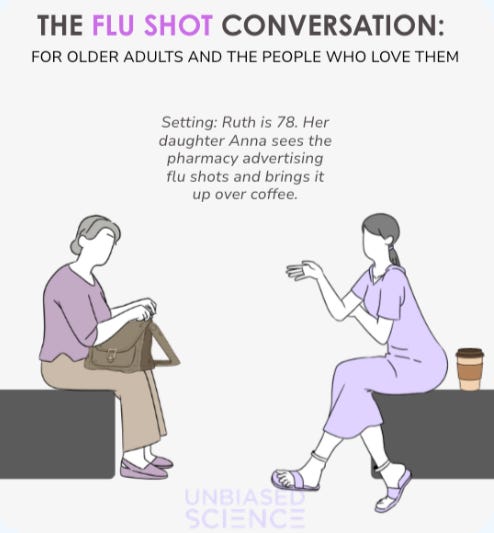
To pair with it, we created a two-page quick reference guide for clinicians and a conversation guide for older adults and the people who love them, which follows 78-year-old Ruth and her daughter Anna as they talk through the flu shot over coffee. Everything is available on our nonprofit website.
This project was made possible with an educational grant from CSL Seqirus. It covers all flu vaccines regardless of manufacturer, doesn’t promote any one brand, and is purely educational. As always, we had complete scientific and editorial control. Please share these resources with your networks!
What else we covered on social media this week
As usual, we covered a variety of topics across our social channels. If you don’t follow us there yet, you can find us on Instagram, Facebook, LinkedIn, Threads, YouTube, and TikTok. Here are a few highlights.
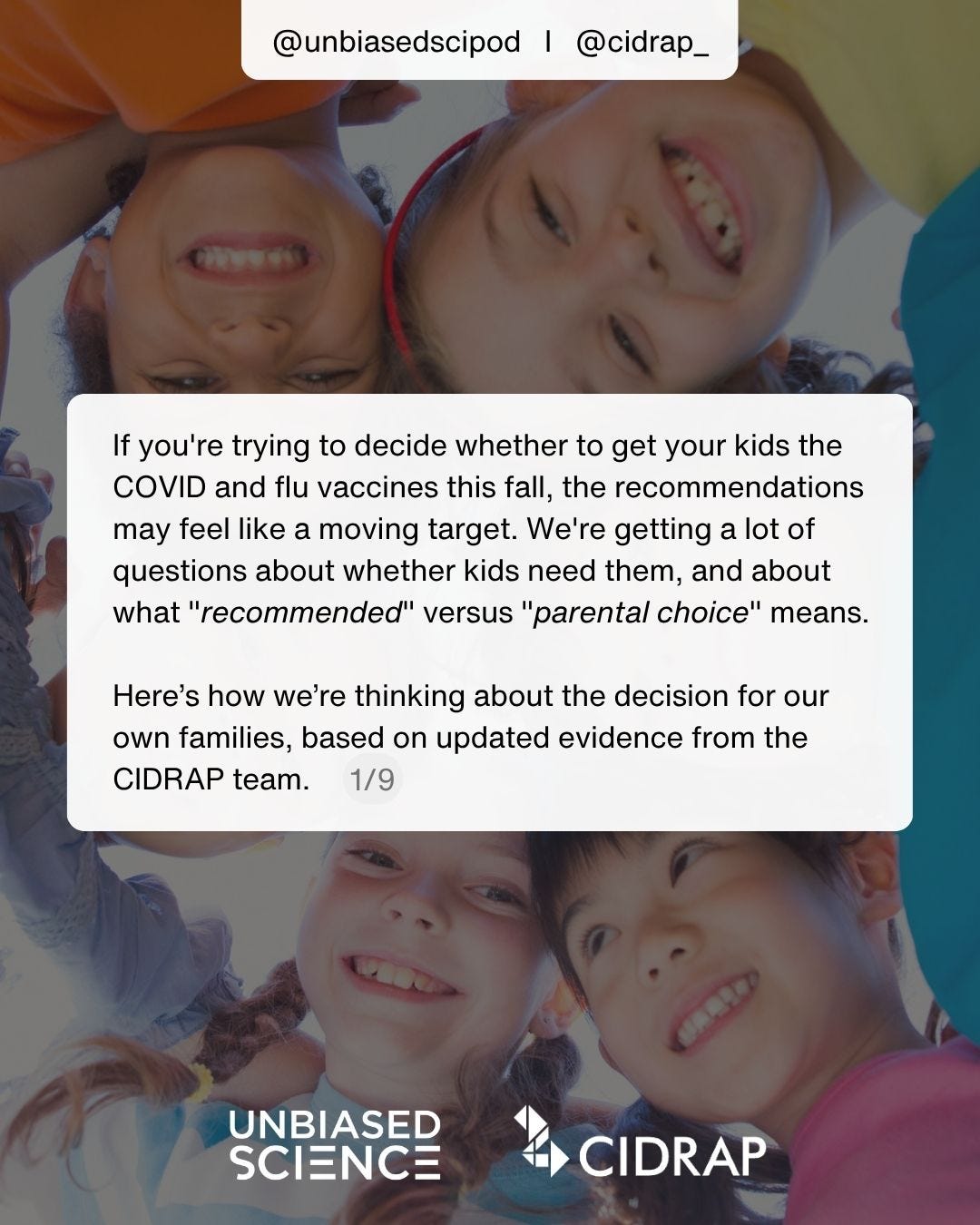
Should your kids get flu and COVID vaccines this fall? In partnership with CIDRAP, and using updated evidence from its Vaccine Integrity Project, we walked through why the American Academy of Pediatrics (AAP) recommends an annual flu vaccine for every child 6 months and older, while its COVID recommendation for kids 2 to 18 is risk-based. Flu deaths in kids are (fortunately) rare, but 1,234 children died from flu-related illness across eight seasons (2016 to 2025, excluding 2020-21), including a record 289 in the 2024-25 season alone. Over those eight seasons, vaccinated kids had about an 80% lower risk of dying from flu than unvaccinated kids. We also explained what “parental choice” means in practice (your pediatrician may not bring up the COVID vaccine for a healthy 8-year-old, but you can ask for it, and the AAP says it should be offered).
Developed in partnership with CIDRAP. See the full post on the Unbiased Science and CIDRAP social media pages. How hard it can be to find mental health care. I was a bit reluctant to share this, but it felt important. I recently took the long overdue step of seeking mental health care, waited weeks for a virtual therapy appointment through my insurance, and learned fifteen minutes in that the service only covered short-term support. My dozen emails to therapists since then have gone unanswered. I’ve been overwhelmed by the support and suggestions for care that poured in (thank you, my village), as well as by how many of you told me you’ve experienced the same thing. I have a doctorate in public health and direct connections to the medical world, and I still can’t navigate the system to find care, so I can only imagine how hard it is for everyone else. This is unacceptable, and we need to get loud about mental health care, which is exactly what I plan to use our platform to do.
See the full post on the Unbiased Science social media pages. Does makeup expire? Does anyone else keep their mascara for years, milking every last drop they can squeeze out of the tube? Cosmetic chemist Kelly Dobos helped us break down what the symbols on our makeup mean and when it’s time to toss a product. The FDA doesn’t require expiration dates on cosmetics, so look for the period-after-opening symbol (a little open jar with a number and an “M” for months) and write the date you opened it right on the product. Kelly is one of many scientific advisors on our multidisciplinary team, which includes physicians, immunologists, and nutrition scientists, so we can bring the right expertise to each question you send us.
Developed in partnership with Kelly Dobos. See the full post on the Unbiased Science social media pages.
We don’t paywall our content, which is why paid subscriptions are such an amazing way to support the work we do. You can also make a tax-deductible donation to the Center for Unbiased Science and Health, our nonprofit and educational engine, where we put resources like the escape room and conversation guides above. We have so many exciting things in the works. Thanks for reading, and for sharing our work with the people in your life.
Stay Curious,
Unbiased Science
Thanks for this informative episode. Big Minnesota pride right here! 🫶
Also loving the new music
I am a retiring psychiatrist. I know finding a therapist is difficult. I would ask friends, primary care providers or your religious leader (if appropriate) who they like. Word of mouth is a better bet than lists or ratings. Many do not take insurance, however with many people's large deductibles this can be a moot point. You pay anyway. Get on a waiting list and call every Monday to politely ask if they have had cancellations. You will get in. I'm old but would say many people prefer in person, at least to start out.