

Still No ACIP Quorum, Collapsing Lawsuits, and Vaccine Questions Answered
The State of U.S. Vaccine Policy
Welcome to our biweekly series in partnership with CIDRAP at the University of Minnesota.
We’re excited about this issue. Alongside the usual policy machinery (charters, quorums, briefing schedules, the works), we’re also pointing you to some of our practical, vaccine-related content that answers commonly asked questions. So we hope this issue is informative and interesting, but also useful.
Let’s discuss…
Still No Quorum, Still Grinding Through Briefs
Since our last issue, little has changed in the American Academy of Pediatrics (AAP) v. Kennedy case. The appeal we previously mentioned is moving through on an “expedited” schedule, meaning briefs are traded back and forth at an accelerated pace. The district court has its own schedule running in parallel, and a joint status report and additional briefing are due this month.
While we wait for the case to play out, it’s important to re-emphasize that the formation of a functioning Advisory Committee on Immunization Practices (ACIP) does not hinge on the outcome of this case. In fact, a committee could be seated relatively soon if appropriately qualified members were placed on the committee through the standard vetting process. As it stands right now, the ACIP quorum problem is a choice, not just a scheduling accident.
Flu Vaccines in the Fall
Writing in a MedPage Today op-ed on June 29th, Richard Hughes IV and Will Walters were asked whether flu vaccines will be available this fall without a functioning ACIP. They think so. Guidance from AAP and American Academy of Family Physicians (AAFP) is standing in as the clinical standard of care, Medicare Part B coverage is required by statute, the Vaccines for Children program runs on an October 2024 resolution that applies regardless of flu strain selection, and AHIP (formerly America’s Health Insurance Plans) has renewed its members’ coverage commitment for the season.
The Affordable Care Act (ACA) does less work here than people assume. It requires only that plans to cover vaccines ACIP has recommended, with a long grace period before new ones kick in. Since flu strains change annually, each season’s shot counts as new, so covering it has always been voluntary. Two other rules—Medicaid’s adult coverage requirement and pharmacists’ authority to administer the vaccine—point back to ACIP by reference rather than naming flu, so both have a technical gap with no current-season recommendation.
The saving grace is history, because the flu vaccine has decades of annual guidance behind it. As Hughes and Walters put it, if any vaccine can make it through a season on institutional memory and workarounds, it’s flu.
Finalized ACIP Charter
We covered the back-to-back ACIP charter rewrites in earlier issues, so we will keep this short. The official version is now posted, and CIDRAP published an excellent debrief if you need an in-depth refresher. Our major takeaway is the tiny but significant language tweaks. Earlier versions of the charter explicitly highlighted that committee members should have vaccine research experience. The new charter simply requires members to “represent a balanced range of scientific, clinical, and public health expertise,” which is broad enough to allow members with little to no vaccine experience to be seated anyway.
High-Profile Legal Cases
Several high-profile challenges were settled over the past two weeks, giving yet another indication that, while state-level policies have been largely unsuccessful in shaping the future of vaccine policy in the U.S., individual cases have moved to the forefront.
A group of employees lost their jobs in 2021 after they were denied a religious exemption for the COVID vaccine mandate. These employees argued that the mandate violated their Title VII right to religious accommodations. A ruling to uphold their dismissal was made at the Second Circuit, so they elevated the case to the Supreme Court. On June 29th, the Supreme Court declined to hear their challenge of New York’s now-repealed vaccine mandate for healthcare workers.
Implication: For now, workers in the Second Circuit can’t claim religious discrimination to get out of an employer’s vaccine requirement backed by a state mandate. The Court’s refusal to hear the case sets no precedent beyond that circuit.
A related suit is running into similar trouble. A federal court in Texas denied class status to FBI employees who alleged the Justice Department discriminated on religious grounds by requiring masking and testing while their COVID-19 vaccine exemption requests were pending.
We previously covered Miller v McDonald (filed in 2023) in which Amish parents challenged New York’s refusal to recognize religious exemptions for vaccines. On June 30th, the Second Circuit reaffirmed its dismissal again, stating that school vaccination requirements are health and safety rules and therefore do not interfere with a child’s religious upbringing. Plaintiffs are expected to re-petition the Supreme Court again.
Implication: In 2019, New York repealed religious exemptions for school vaccine requirements. The Second Circuit reaffirmed that this repeal is, in fact, constitutional.
On June 26th, President Donald Trump’s Religious Liberty Commission delivered a draft report in which several of the recommendations relate specifically to vaccines. In brief, the report frames vaccine mandates as a threat to religious liberty. Among other things, it urges restoring retirement and re-enlistment eligibility for service members who lost benefits over religious exemptions to the COVID vaccine.
Implication: This report is advisory and not binding, so it doesn’t mean anything for now. However, it does illuminate a clear path toward where the administration will push on religious exemptions next (and it lines up with the two New York cases above, as well).
Andrea Shaw is an Idaho mother who became a lead plaintiff in the Children’s Health Defense (CHD) racketeering lawsuit against AAP. Last year on a CHD-produced show, she claimed her 18-month-old twins died shortly after receiving vaccines. The lawsuit was largely built on this claim, but on June 29th, a grand jury indicted Shaw on two counts of first-degree murder. Prosecutors alleged that she suffocated the twins, Shaw denies the charges, and the case has not yet gone to trial.
Implication: This claim of vaccine injury has been used to scare parents away from the recommended childhood vaccine schedule, and in particular, the hepatitis A, DTaP (diphtheria, tetanus, and pertussis [whooping cough]), and flu vaccines. The indictment underscores that each of these vaccines is safe and effective. Two children are dead, and neither the recommended pediatric vaccine schedule nor the vaccines themselves are to blame.
A Permanent CDC Director, Maybe
As a reminder, Dr. Susan Monarez served as director of the Centers for Disease Control and Prevention (CDC) for less than a month in the summer of 2025 before she was fired, and the grounds on which she was fired (e.g. standing up for science) are well-described in her subsequent testimony to the Senate Committee on Health, Education, Labor and Pensions. Jim O’Neill then served as acting director for less than six months. Since February 2026, Dr. Jay Bhattacharya has been serving as both the director of the National Institutes of Health and the acting director of the CDC. The CDC has been operating without a permanent director since August 2025.
Now, a concrete step has been made toward filling that role. Dr. Erica Schwartz, President Trump’s nominee, will appear before the Senate HELP Committee on July 15 for her confirmation hearing. Schwartz previously served as deputy surgeon general during the pandemic, is a board-certified preventive medicine physician, and has no public record of opposing vaccines, which makes her a more conventional pick than some earlier names. Senator Bill Cassidy, who has been openly skeptical of Kennedy’s approach to vaccine policy, chairs the committee and called her “very impressive” after meeting her. If confirmed, she has pledged to divest her healthcare holdings and recuse from matters involving former employers.
Real Vaccine Questions Answered
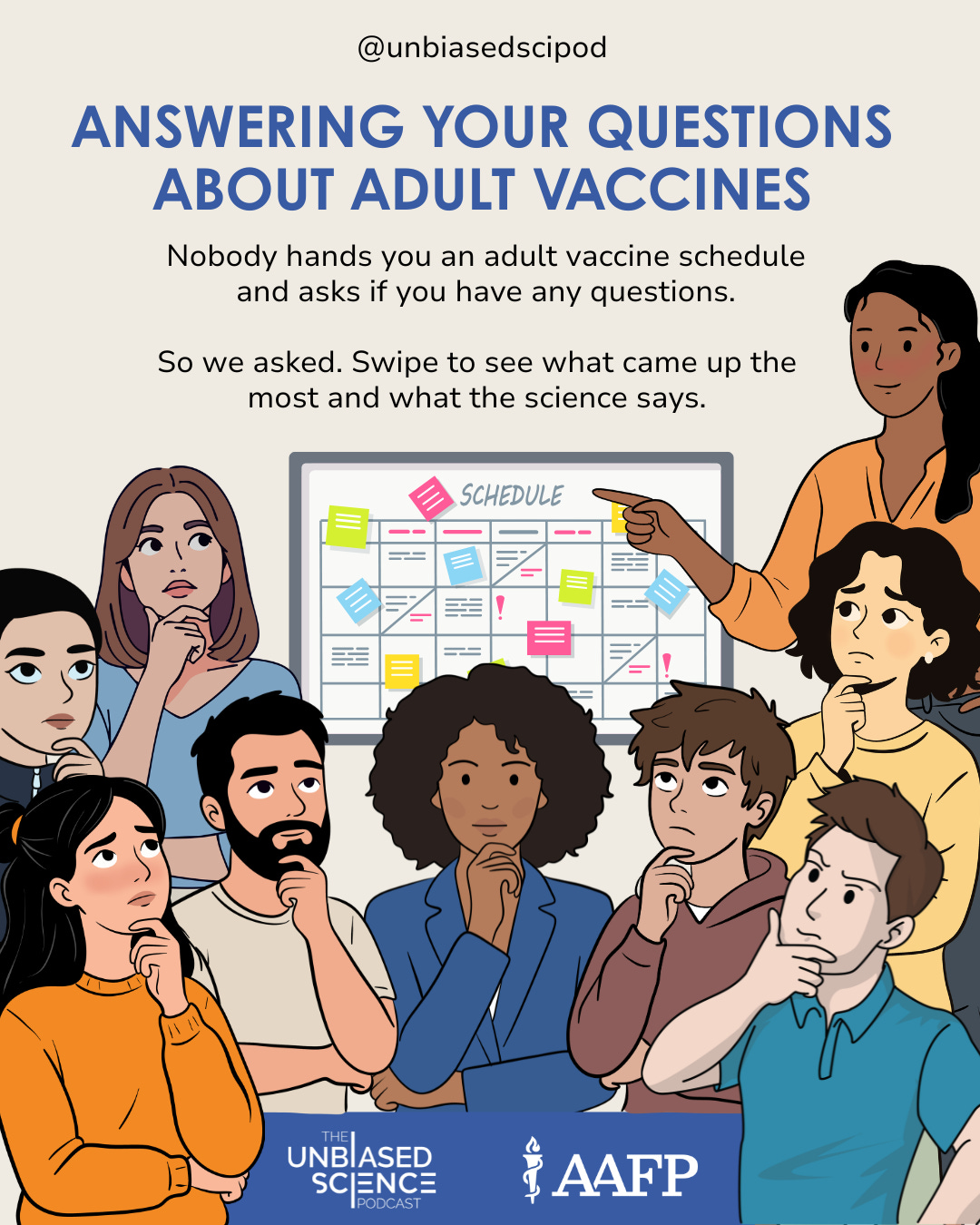
Nobody hands you an adult vaccine schedule and asks if you have any questions. So we asked our audience what they wanted to know, and answered the most common ones in a paid partnership with the AAFP. A few of the questions we tackled:
"Every time I get the flu shot, I get the flu. When I skip it, I'm fine."
The flu shot can’t give you the flu. What people usually feel is either an unrelated bug, an infection from an exposure around the time of vaccination, or the immune response itself. An important note: the flu vaccine is really good at keeping us out of the hospital (and the morgue) but less effective against infection itself. Still, it absolutely can’t give you the flu!
"Is the HPV vaccine worth it if I'm over 27?"
It’s one of only two vaccines we have that prevent cancer. Routine recommendation stops at 26, but ages 27 to 45 fall under shared decision-making with your doctor. (Also, make sure your insurance will cover it!)
"Is my MMR [measles, mumps, and rubella] immunity waning now that I'm 45? Do I need a booster?"
Most likely not. What matters most is how many doses you got, and antibody blood tests (aka titers) aren't reliable for settling this. If you’re not sure if you’re fully vaccinated, it won’t hurt to get a dose of MMR.
"Why aren't adults over 23 offered the MenB [meningococcal] vaccine?"
Risk is highest in teens and young adults and low for healthy adults, which is why it isn't routine over 23. But specific groups (no working spleen, certain immune conditions, lab workers) do need it.
“Do adults need vaccines like kids do, and whose job is it to tell you when they're due?”
Vaccines are recommended for adults but not required in the way that childhood vaccines are as a condition for school entry. Your family doctor or clinician should flag what is due, but sometimes it falls on you to ask.
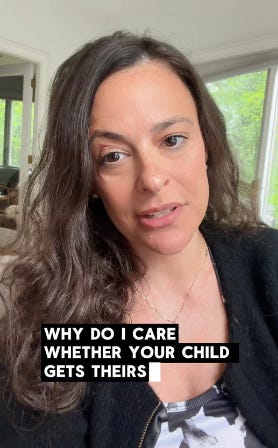
Why do I care if your child has the MMR vaccine if my kid is vaccinated? We made a short video on the question, because it’s one that we hear the most. For the answer, we need to talk arithmetic!
The MMR vaccine is 97% effective, which means that, out of every 100 vaccinated people exposed, about three can still get infected. When measles is rare, that gap almost never comes up, because you barely cross paths with the virus. When measles is circulating widely, the exposures pile up and that small percentage keeps getting tested.
Add in that immunity can wane, and that measles can erase parts of the immune system’s memory (immune amnesia), then the case for community coverage gets concrete fast. Your protection is real, and it holds best when it isn’t being battered constantly.
As always, we have a dedicated inbox for your questions about vaccines and vaccine policy. If you saw something in the news, are questioning a claim a relative shared, or have a burning vaccine policy question you can't get a straight answer to, send it to vaccines@unbiasedscience.com. Your questions shape what we cover.
What Else We’re Watching
New emails show how early the federal chill on vaccines began. Reporting revealed that Kennedy directed the CDC to take down any campaigns promoting the flu vaccine in February 2025 shortly after he began his new role. Former CDC official Debra Houry also described the chaos around the new ACIP appointments on Face the Nation.
A COVID-19 injury table is coming to the compensation system. The Health Resources and Service Administration (HRSA) is preparing a proposed rule to establish a COVID-19 injury table under the Countermeasures Injury Compensation Program, which would let claimants with listed injuries skip proving causation from scratch. A narrow, evidence-based table (think myocarditis after mRNA vaccination, or anaphylaxis in a defined window) is overdue and reasonable. We’re watching the scope, though, because the governing statute requires “compelling, reliable, valid” scientific evidence of direct causation. There is concern about whether the table stays inside that line or gets stretched to support weakly supported claims. The rule isn’t posted yet; we’ll read it closely when it is.
MAHA parents still vaccinate. A new poll found that 86% of self-identified MAHA (Make America Healthy Again) parents say the MMR vaccine is important to their families and communities. The loud online fights aren't the whole story, and they never were.
Your Voice Matters!
While much plays out at the state and federal levels regarding vaccine policy, you don’t have to have a job in the government or be a lawyer to show up. Here are two places where your voice really matters right now:
In Massachusetts, a house bill (H.2554) would eliminate religious exemptions for school vaccine requirements while leaving medical exemptions in place. The formal legislative session ends on July 31st. If you are a Massachusetts resident, it’s not too late to contact your legislators before that window closes.
A White House proposal could entirely reshape for ill how federal science is funded and conducted. The public comment period ends on July 13th, and individual comments carry more weight than form letters. Your comment does not need to be long or technical to make a difference. Here is more information about the proposed ruling and where to submit your comments.
One scheduling note: we’re taking a short summer break. We’ll be back on July 30th to catch you up on whatever happens while we’re gone (and, given the pace lately, there will be plenty!) The pause is partly for a very good reason: our own Izzy Brandstetter Figueroa is in the home stretch to defend her dissertation and earn her PhD in epidemiology. Go, Izzy!
Stay Curious,
Unbiased Science
This piece is cross-posted with CIDRAP.
 | A guest post by
|
 | A guest post by
|
I expect Dr Schwartz’s nomination for CDC director to go through. What happens after is critical.
She has clear evidence that if she tries to buck RFKs vaccine moves, she may be fired. But the political backlash to Monarez was significant, enough that it led to Schwartz’s nomination.
Levers she has: she has to sign off on any ACIP recommendations. She can inform how CDC staff contribute to ACIP meetings. Ultimately she can threaten to publicly disagree with Kennedy and risk firing.
Will she do these things? Will Kennedy back off? Would Trump risk losing the MAHA coalition completely by firing Kennedy if he fears more backlash to another CDC director firing?
Who knows? Honestly, too much politics for me when we should really be focusing on robust vaccine education, VPD surveillance and closing vaccine access gaps, yet this is the world we live in.
So curious to hear more about that Idaho CHD lawsuit and how it develops. I know CHD and similar groups have very active legal teams centered around certain case studies and I’ve always wondered how genuine their claims are. Eg. If an individual was really harmed by a vaccine or if it was just coincidence/something else happened as may be the case for this Idaho trial. Fantastic work as always Unbiased Science team!