

Two weeks into my public health graduate career, in an intro to bioethics course, the professor asked for a show of hands on whether people who receive government assistance should have to pass a drug test. The supporters went first, so I put my hand up, looked around, and saw that mine was the only one. I was confused, because I had assumed the room would split. My classmates were furious, and one asked if I was serious and why I would enroll in public health if I was conservative. Conservative? That was news to me. I had been in the program for two weeks, and I already had a label.
Putting aside red or blue, I was very green. I hadn’t had a single lecture on the social determinants of health, and I hadn’t given much thought to the people the policy was aimed at. They need help feeding their kids and paying rent, and the policy treats needing that help as reason enough to suspect them of drug use. If they get turned away, I couldn’t have told you where they were supposed to go instead. My stance has evolved a lot since then, and it didn’t hurt to learn that the states that tried it spent hundreds of thousands of dollars and had very little to show for it. Even so, typing this now, I’m terrified of the blowback over a show of hands many years ago and a position I no longer hold, which makes me wonder how colleagues feel about the views they still hold.
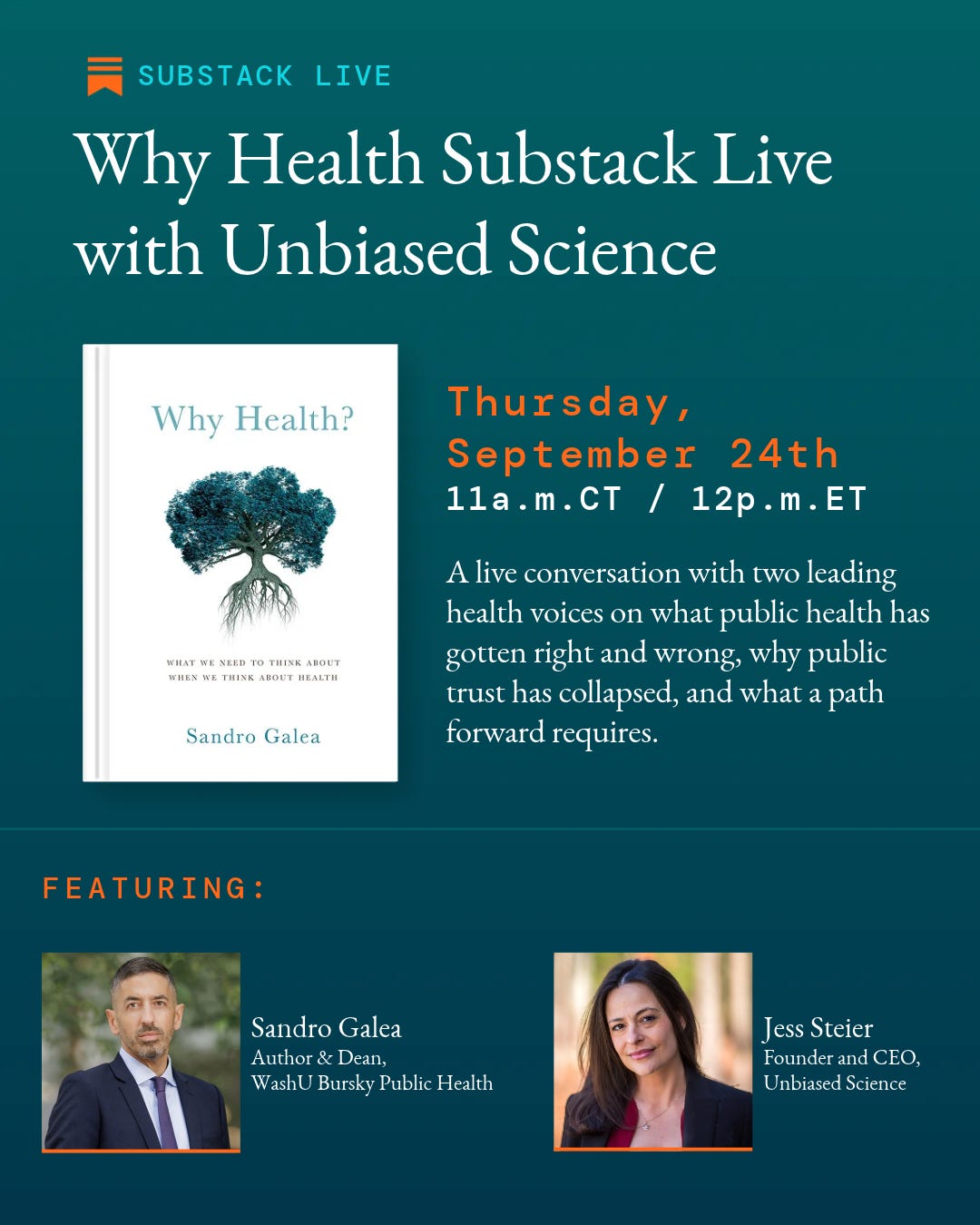
I’m not the only one wondering. On Thursday I’m sitting down with Dr. Sandro Galea, dean of the WashU Bursky School of Public Health, for a Substack Live about his new book, Why Health?, and the Purple Public Health Project he launched with Dr. Salma Abdalla. Their launch essay describes colleagues who share dissenting views only in confidence, including one who told them, “I worry I will lose my public health card.” They’re clear that purple is different from centrist, and that many of the field’s core values are progressive and should stay that way. They start from common ground. “I have yet to meet anybody who doesn’t want their children to be healthy,” Dr. Galea said on a recent episode of Why Should I Trust You?, and if everyone shares that goal, public health shouldn’t belong only to the people who vote blue. So, can public health be purple? I think it can, if we stop doing what my classmates did that day, which was to hear one opinion and decide they knew everything else about me. Let’s discuss…
Public health can’t avoid politics, because many of its tools are policies
Those of us who cover health policy get told to stay out of politics and stay in our lane. Nearly half of U.S. adults now say scientists should stick to the facts and stay out of policy debates. The usual comeback is that health policy is inherently political, and I agree. Dr. Galea made the same argument in 2019 in an editorial with Dr. Roger Vaughan, writing that the conditions that shape our health (housing, work, clean air) all come out of political decisions.
Many of public health’s most powerful tools are policies, too, like mandates, taxes, closures, and school-entry requirements. Much of the field’s work never bothers anyone (food safety, disease surveillance), and the fights happen where it constrains individual choice, because plenty of people experience that as infringing on their rights.
Medicine is different, since it happens one patient at a time, with consent, and the patient can always say no. Dr. Galea made the same comparison on the podcast, noting that medicine is broadly seen as belonging to neither party while public health is read by many as an extension of progressive politics.
Sixty years ago, he pointed out, requiring seat belts was controversial even though the science on whether they save lives was already clear, and the objection was to being told what to do by the state. He said we still make that kind of trade with speed limits, since dropping every road in the country to 25 miles an hour would save thousands of lives a year and nobody proposes it. He doesn’t think there’s any way to act at the population level without bumping into people’s values, and he thinks that’s okay (I agree). So, public health isn’t getting out of politics, though political and partisan are different things, and I think the field can be far less partisan than it is.
I get labeled from both directions
When people want to hurt me online, a favorite line is some version of “a doctorate in public health (laughing emoji), what kind of liberal malarkey is that?“ If you work in public health, people assume you’re a bleeding-heart liberal, and the stereotype has some basis, since the field does skew left. (In a 2018 survey of Society for Epidemiologic Research members, 72% called themselves liberal or left-leaning and fewer than 5% called themselves conservative.) It doesn’t fit everyone, because within the field there’s a spectrum and most of us move around on it depending on the topic. In an ideal world, someone could read Unbiased Science for a month and have no idea how I vote. The reality is that some of my stances get read as a giveaway, and that’s because a handful of loud politicians turned them into party positions. Vaccines are the obvious example, even though 85% of Republicans and 96% of Democrats say childhood vaccines are safe, majorities of both parties support school requirements, and vaccine skepticism has always had a home on the crunchy, all-natural left as well as the right. Dr. Galea made a similar point, that the headline-grabbing fights are the exceptions and that most people, red or blue, agree on most of the core tenets of public health.
Within public health, I’ve been labeled the other way. A while back I wrote about how I approach masking. I think masking is one of the most incredible mitigation tools we have, and I use it in some situations (medical offices, crowded places, planes) and skip it in others. I said so, and I said that none of us calculate risk only through the lens of public health, because we’re weighing other things, too. I heard from people who describe themselves as skeptics of public health, and they said the message felt practical and didn’t feel authoritarian. I also heard from colleagues who were angry, and some of them treated the post as evidence of which “side” I was on.
So, some people hear me talk about vaccines and assume I’m on the left, some colleagues read my masking post and assume I’m on the right, and both are doing what my classmates did, taking one position and filling in all the others. Even if I can’t avoid that, I want people from both sides of the aisle to find Unbiased Science a place where they can ask a question without having politics thrown in their face or their own politics insulted.
What a purple public health would do differently
Dr. Galea describes two jobs for academic public health: producing the science dispassionately and taking part in the conversation about values. And he thinks we get into trouble when we conflate them. I agree, though I don’t think the two can ever be pulled apart completely (and I plan to ask him how clean he thinks the separation can be). Dr. Kristen Panthagani has written that the scientific method can tell us what outcomes to expect from our choices and has nothing to say about which choice is right, so two people can accept the same data and still disagree for reasons that have nothing to do with the science. Calling one of them anti-science is inaccurate, and it doesn’t help.
Values get in before the data exist, too. In their newest piece, Dr. Galea and Dr. Abdalla point out that funding and incentives help determine which questions get studied in the first place, and they argue for being transparent about it. When it comes to masking, the science can tell us how well a mask filters, while whether to wear one at Costco is a decision people make with their values as well as their risk.
One of the hosts recalled a Braver Angels town hall about the pandemic response, where a man told Dr. Francis Collins, who led the NIH during COVID, that he appreciated the effort to save lives, that it had cost him his business, and that he wanted to know why livelihoods hadn’t been factored in. Dr. Galea’s answer was that saving as many lives as possible is more complicated than picking whatever prevents the most deaths right now, since livelihoods and schooling shape people’s health for decades. A purple public health, as I read it, keeps the evidence the same for everyone, is honest about what the evidence can’t decide, and makes room in the conversation for people who weigh competing values differently.
I also think it would give ordinary people more grace, and I know some of my colleagues will read even that as selling out. We’re all products of our environments, and those environments (and the algorithms feeding them) keep getting more polarized. If everyone I knew and loved told me vaccines were dangerous, I might believe it, too, so it doesn’t surprise me when someone in that position does. I’ve talked before about disenfranchised grief, which is grief that the people around you don’t recognize as legitimate. One example is the families of unvaccinated people who died of COVID and were made to feel they had no right to mourn. With measles all over the news (unfortunately), I want to ask Dr. Galea whether we’re too hard on people who don’t do what we recommend.
I have far less patience for people with power and platforms who keep those claims going, and engaging with them is a different and harder question. The launch essay separates good-faith disagreement about methods and priorities from bad-faith efforts to undermine the public’s health. The hosts read Dr. Galea a line from a recent piece in The Nation that called engagement with MAHA “collaborationist,” and he has colleagues who consider talking with this administration’s health leadership a form of complicity. His answer was that we can do both, staying unequivocal about what the science shows (he used childhood vaccines as the example) while still having the conversation. He said the question he asks himself all the time is “What am I trying to achieve?” His view is that refusing to talk can produce more fighting, and the goal he has in mind is health for all. He also said everyone should have a line they won’t cross, that it “should be very, very far,” and that most of what we’re fighting about isn’t across it. I want to ask where he draws it.
He starts hard conversations with what the two sides agree on before getting precise about where they disagree, which is the approach I try to take, too. It’s what I mean when I talk about meeting people where they are, bridge-building, and connection before correction. We all want health for ourselves and the people we love, and where we tend to split is on how to get there, which is a disagreement we can have a conversation about. I’ll also ask what the pushback to purple public health has looked like for him, and how his thinking has changed since that 2019 editorial.
Dr. Galea and Dr. Abdalla wrote this summer that the goal isn’t to get everyone to agree with public health, and that the field has to learn to work with disagreement. I’d like the next first-year student who raises the lone hand to be asked why she thinks so before anyone decides what she is.
We go live Thursday, September 24 at 12p EST. If you have a question for Dr. Galea, leave it in the comments and I’ll work in as many as I can!
Stay Curious,
Unbiased Science
Good article. As someone who followed and supported just about every mandate and mitigation effort promulgated during the height of the pandemic, I have yet to read a solid, science based review and analysis of where we overshot, where we undershot, and what a "more perfect" (since with multiple trade-offs, I doubt anything could be perfect), national response would have looked like, balancing short-term issues (people dying at the moment, health systems being overwhelmed) and long-term outcomes (e.g., long term impact on students, long term impact on social cohesion). Maybe that study is out there, but I haven't found it yet.
As I was reading, I was composing in my head how I would respond, and you deftly anticipated pretty much everything. Well done. My only tidbit of contribution would be that some public health policies have a built in trade off between how compulsory they are and how effective. That trade off is not inherently left or right, conservative or progressive, as we're seeing now. For the authoritarian, individual liberty is just a talking point until it gets in the way of the latest grab. To the extent policy makers and politicians can engage in a good faith discussion about the freedom/effectiveness tradeoff, sure, let's have that discussion, but good luck finding smart electeds willing to have that debate publicly.